BLOCKS OF PERSPECTIVE: The Difficulties of Living in a Three-Dimensional World
- Apr 22, 2017
- 5 min read
How is it possible that two honest people can look at the same thing and see it completely differently? The answer, of course, is perspective!
In my work as a psychologist I have found that a person's inability to see different perspectives of the phenomena of their lives is the biggest cause of interpersonal conflict and psychological distress.
If I were to ask you what the color was of the object below, you would likely answer "blue" (unless you were color blind).
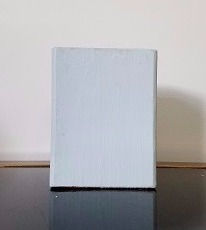
The object in the picture is a painted wood block. The side of the block you are seeing in this first picture is blue. However, the block has six sides, and if I were to show you a different side and ask you what the color was of the block was, you might say a different color...

The side of the block shown in this second picture is brown. Pictures are two-dimensional (2D) objects; but blocks are three-dimensional (3D) objects. The block in this picture has six sides: four painted blue and two painted brown

I use this block in my work with patients to demonstrate how limitations of perspective can lead to myriad misunderstandings. If I am working with a couple in conflict, what I usually do is provide one partner a view of the block that shows three of the blue sides and give the other partner a view of the block that only has the brown sides visible. When I ask each of them to tell me what color the block is, they usually respond by naming the color of the sides that they are able to see. If we are in agreement that no one is lying, it then becomes obvious to them that the sides of the block that lie outside of their view must be a different color than the sides that they can see.
From a physical perspective, it is impossible for us with the naked eye to see any more than three sides of this six-sided block; however, depending on the size and perspective we are shown of the block, we may be even further limited and only be able to see a single side of the block (as in the first two pictures above).
Matters become further complicated when we are shown 2D pictures of 3D objects. Those pictures can be cropped in such a way that it may look like the object in question is itself a 2D object, when it is actually a 3D object, and hence, we are left to wonder if we are looking at the only side of a 2D picture or just one of the sides of a 3D object.

At this point, you may understand how our colored block can illustrate the misunderstandings that result from differences in physical perspective, but you may be wondering what lessons this metaphorical object can teach about more complex psychological and interpersonal phenomena. Let me illustrate with an anecdote:
Through a series of unfortunate circumstances, Peter, a 25-year-old male, is in debt, owing about $150,000 to various institutions (e.g., college loan companies, credit card companies, doctor's offices, etc.). He believes that he has been forced to accrue so much debt because his parents have been unable to pay the expenses of his basic needs - expenses that his friends' parents pay for for them (e.g., food, rent, medical care, school tuition, etc.).
His parents, however, tried to support Peter as best they could, but a series of unfortunate events in their own lives (e.g., the untimely death of his father when Peter was 13) left his mother hamstrung in her ability to help him financially.
Recently, Peter asked his mother for help paying off his debt, fearing that the longer he stays in debt, the more it will impact the future of his life. His mother, who only has about $5,000 of discretionary savings, begged her second husband, who has no obligation to help Peter, for an additional $5,000. Her husband obliged, but this led to a negative shift in their relationship. So Peter's mother gave Peter $10,000 to help him, at great cost to herself (she now has no personal savings and her marriage is in conflict).
Peter accepted her gift and is gracious, but deep down he believes it is too little too late, as he is still $140,000 in debt and has no hope of crawling out from under it. The two have an argument. In the eyes of Peter's mother, she has given him all she has and more, and at great cost to herself. In Peter's eyes, her $10,000 gift is nice but not nearly enough to truly help him and her efforts are the latest example of how his parents (and in this case, his mother) never go the full nine yards to help him and always fall short of satisfying his needs.
Who is right and who is wrong? Perhaps it is better to ask; "What color is the wood block?" Metaphorically speaking, Peter sees the wood block as blue, because his perspective prevents him from seeing the brown sides of the block, which his mother sees. Similarly, his mother's perspective reveals only the brown sides of the block, with the blue sides completely out of her view.
How then to proceed?
The first step is to get all parties to acknowledge that the problem, much like the wood block, is three-dimensional, with several different sides. The second step is to reveal the missing sides of the problem that each person was previously unable to see. Hopefully, at the very least, this exercise will demonstrate how it is possible for the other person to be conveying a genuinely honest difference in what they see. If this is successful, the ensuing validation can set the stage for successful resolution of the problem in the next stage.
Each problem is unique and requires a unique set of resolutions, but it is impossible for any of the resolutions to be successful if there isn't first acknowledgement and validation of the fact that the problem is three-dimensional and that it is entirely possible to see an opposing perspective on the problem without lying.
Sociopolitical Problems
Expanding outward to the socio-political sphere, the problems we face - such as climate change, healthcare and perpetual budget deficits - are similarly complex and 3D. However, in addition to the problems themselves, the biggest obstacle to their resolution is that opinion leaders on each side only see these problems as being 2D. If we liken our socio-political problems to a 3D Rubik's Cube, we can see the obstacles even clearer.

At best, the "problem solvers" of our world, limited to a 2D view of the problems we face, only see three of the six sides of the of the Rubik's Cube. At worst, they may only see one side. If you've ever tried to solve a Rubik's Cube, you know how hard it is to solve just one side (one color) of the puzzle. However, solving one side usually leaves the other five sides in disarray. Furthermore, when you try to solve any of the other sides of the Rubik's C
ube, your efforts usually lead to messing up the one side that you actually did solve, now leaving it unsolved as well.
Does this sound familiar? My guess is that it not only sounds familiar to those who have toiled with a Rubik's Cube but also to those who have genuinely tried, from all political persuasions, to solve many of the problems our country and our world faces. It is comparatively easy to solve one side of any problem, just as it is comparatively easy to solve one side of a Rubik's Cube, leading to many of the premature celebrations we often witness in the political sphere. What is truly difficult, however, is to solve all sides of a 3D problem.
How do we start? The first step is simply to acknowledge that the problems we face are 3D and multi-sided, with many of the sides blocked from our view due to our limitations in perspective.


Comments